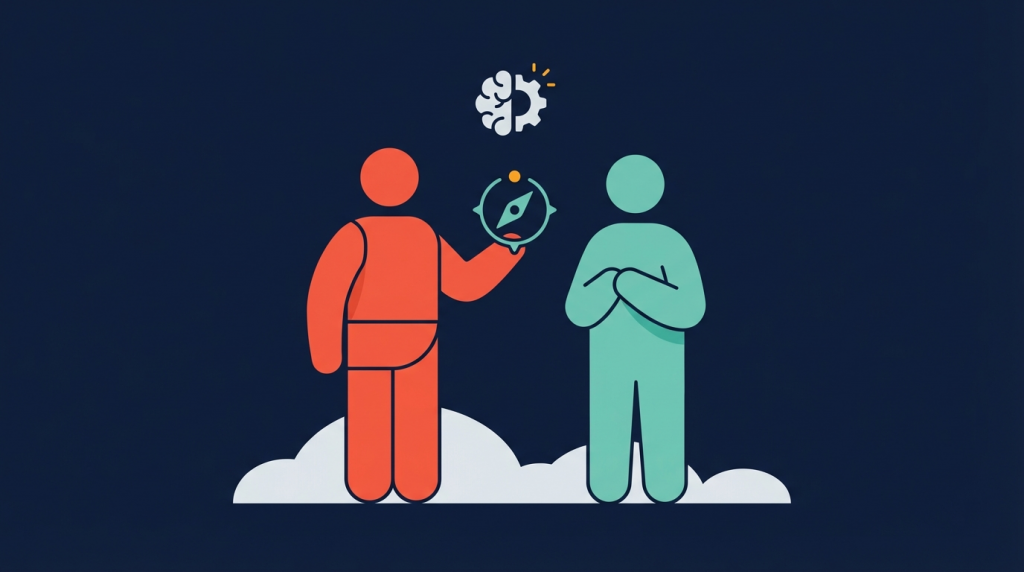
- Meta's Andromeda update shifted targeting control from advertisers to the AI.
- Interest-based and demographic filters no longer drive who sees your ads.
- The creative itself is now the primary targeting signal Meta's algorithm reads.
- Small businesses running the same strategy as 2022 are losing money, not reach.
- Broad audiences outperform narrow ones when your creative does the qualifying work.
- Winning on Meta now means feeding the algorithm the right signals, not fighting it.
- One strong creative concept built around your ideal customer beats ten interest stacks.
Meta ads AI control has fundamentally changed — and if your campaigns stopped performing without any obvious reason, this is almost certainly why. Meta’s Andromeda algorithm update has shifted the way ads are delivered at a foundational level. The targeting strategies that worked reliably for years no longer function the same way. According to multiple performance analyses, advertisers who have adapted to the new system are seeing 20–35% higher ROAS compared to those still running legacy campaign structures. This guide explains exactly what changed, why it’s affecting small business owners the most, and what a winning approach looks like in the new reality.
What Changed: The Andromeda Shift Explained
For years, Meta ads worked on a relatively predictable model. You defined your audience — age ranges, locations, interests, behaviours — and Meta delivered your ads to the people inside those parameters. You had a sense of control. You could test audiences the way you tested creatives.
Andromeda changed that model completely.
Meta’s Andromeda system is an AI-driven ad delivery engine that de-emphasises advertiser-defined targeting in favour of algorithmic matching. Instead of relying on your interest stacks or demographic filters to find the right audience, the system analyses your ad creative — the images, video, copy, tone, and context — and uses that information to determine who should see it. According to Meta’s own engineering documentation, Andromeda represents a 10,000x increase in model complexity over the previous system — not a minor tweak, but a complete architectural overhaul of how ads are retrieved and matched.
In practice, this means Meta is now reading your creative as a signal. The algorithm infers your intended audience from what your ad looks like and what it says, not from what you typed into the targeting fields. Your carefully built audience segments have become, at best, a loose suggestion.
This shift did not happen overnight. Andromeda was officially announced by Meta in December 2024 and completed its global rollout across all advertising accounts by October 2025. By early 2026, it is the default delivery infrastructure for virtually all Meta campaigns. Many advertisers are only now realising why their results changed — because the platform changed underneath them without a prominent public announcement directed at small business users.
Why Small Business Owners Are Struggling Most
Large advertisers with dedicated media teams adapted quickly. They had the resources to test new creative approaches, analyse delivery patterns, and rebuild their strategy around the new system. Small business owners, running campaigns on their own or with limited support, were left with a playbook that no longer worked and no clear explanation of why.
The most common pattern looks like this: a business owner has been running Meta ads for two or three years. The same targeting setup — a saved audience built around competitor interests, a specific age band, a geographic radius — delivered consistent results. Then, somewhere in the past twelve to eighteen months, results became erratic. Some weeks nothing. Other weeks unexpected reach to audiences that seemed wrong. Cost per lead climbed. ROAS dropped.
When they searched for answers, every guide said the same thing: “trust the algorithm.” That advice is accurate but useless without context. Trust the algorithm to do what, exactly? With what inputs? The missing piece is understanding that Meta’s AI is not broken — it is working differently, and it needs different inputs than the ones most small businesses are still providing.
The businesses that relied most heavily on granular targeting — local service businesses, niche e-commerce, professional services — have felt this the hardest. Their entire strategy was built on precision. Andromeda made precision-by-targeting largely obsolete. Precision now has to come from somewhere else.
The Black Box Problem: What Meta’s AI Is Actually Doing
One of the most frustrating aspects of Meta ads AI control is the opacity. You cannot see exactly why a particular ad reached a particular person. You cannot inspect the AI’s reasoning. You see outcomes — impressions, clicks, conversions — but not the logic that produced them.
This is the “black box” problem, and it is real. But understanding what the algorithm is optimising for helps reduce the frustration. Meta’s own published results report that Andromeda has delivered a +6% improvement in recall and +8% improvement in ads quality on selected segments — meaning the system is finding better matches, not worse ones. The problem for most small businesses is not that the algorithm performs poorly. It is that it is receiving weak creative signals to work with.
Meta’s system is optimising for conversion outcomes, not audience membership. It does not care whether someone is in your interest-based audience. It cares whether a given person — based on their entire behavioural history on Meta’s platforms — is likely to take the action your campaign is optimised for. The algorithm is asking: given everything we know about this person, and given what this ad is communicating, is this a likely match?
The creative is its primary input for the latter question. A generic ad with weak signals gives the algorithm very little to work with. It cannot confidently match your ad to the right people if the ad itself does not clearly communicate who it is for and what action it wants them to take. Broad, vague creative gets broad, vague delivery.
Specific, signal-rich creative — an ad that speaks directly to a real problem, uses language your ideal customer actually uses, and shows a clear and believable outcome — gives the algorithm the information it needs to find the right audience on your behalf.
The New Playbook: Creative as Targeting
The most important shift in how to approach Meta ads AI control is this: your creative is now your targeting strategy. The ad itself does the qualifying work that interest stacks and demographic filters used to do. The data supports this directly: Lebesgue’s 2024 analysis of Meta campaign performance found that broad targeting strategies delivered 49% higher ROAS compared to narrow lookalike targeting approaches. The shift is not marginal — it is structural.
This is not a minor tactical adjustment. It is a fundamental rethink of how campaigns are built.
Under the old model, you could run a moderately good creative and compensate with tight targeting. If the ad reached the right people, conversions would come. Under the Andromeda model, tight targeting has limited impact. What matters is whether the creative is specific enough, relevant enough, and compelling enough for the algorithm to recognise who it should reach — and for that person to take action when they see it.
What this looks like in practice:
- Speak to one person, not a demographic. Write copy as if you are talking to a specific individual with a specific problem — not a market segment. The more precisely your ad mirrors a real customer’s internal language, the stronger the signal you give the AI.
- Lead with the problem, not the product. Andromeda’s delivery is heavily influenced by early engagement signals. Ads that hook people with a recognised problem outperform ads that lead with features or brand identity.
- Use social proof with specificity. Testimonials, results, and case references that name a recognisable situation — not generic five-star claims — generate stronger engagement signals.
- Test creative concepts, not audience variants. The productive testing variable has shifted from audience to creative. Multiple creative concepts against a broad audience will tell you more than one creative tested across multiple interest segments.
Practical Steps to Adapt Your Meta Ads Strategy
Moving from an audience-first strategy to a creative-first strategy requires a structured approach. Here is where to start.
Audit your current creative library
Look at every active ad and ask: does this ad clearly communicate who it is for, without relying on the targeting to do that job? If the answer is no, the ad is giving the algorithm weak signals. Identify your strongest performers and reverse-engineer what made them work — then apply those patterns deliberately. For reference, Meta’s own engineering data shows that advertisers who switched on Advantage+ Creative’s AI-driven features saw a 22% increase in ROAS — a result driven almost entirely by giving the algorithm better and more varied creative to work with.
Simplify your audience structure
Narrow audience stacks are no longer your primary lever. Move toward broader audiences — Advantage+ audiences or open targeting with location and basic demographic constraints only. Let the creative do the qualifying. Resistance to broad audiences is usually a sign that the creative is not specific enough to do that job confidently.
Rebuild your creative around customer language
Pull the actual words your customers use when they describe their problem — from reviews, inquiry messages, sales conversations, or support tickets. Use that language verbatim in your ad copy. The algorithm responds to creative that generates genuine engagement, and nothing generates engagement more reliably than the exact words a person uses to describe their own situation.
Consolidate your campaign structure
Many small business accounts are over-segmented — multiple campaigns targeting slight variations of the same audience, splitting the learning budget and confusing the algorithm. Consolidate to fewer, larger campaigns. Give the algorithm enough conversion data per campaign to optimise effectively. According to Search Engine Land’s analysis of Andromeda and GEM, a practical no-touch window is a minimum of 50–75 conversions per ad set before drawing conclusions — committing to that window is where most small businesses lose patience and reset campaigns prematurely.
Measure the right outcomes
With Andromeda, delivery patterns can look unusual even when campaigns are performing well. Reach may include audiences that seem unexpected. This is not a sign of misconfiguration — it is the AI finding people the interest filters would have excluded. Judge campaign health on conversion outcomes, not on whether the audience looks like your old targeting.
What Not to Do: Mistakes That Make It Worse
There are several common responses to declining Meta performance that make the situation worse, not better.
Do not layer more interest restrictions. Adding more targeting layers in response to poor results reduces the algorithm’s room to optimise. It also reduces your budget’s ability to reach the people who would actually convert. More restrictions means less data per audience segment, which means slower learning and worse delivery.
Do not change campaign settings too frequently. Every significant change to a campaign — audience, budget, objective, creative — resets the learning phase. A campaign that is reset repeatedly never builds the conversion history needed for Andromeda to deliver well. Make fewer, more deliberate changes and give each version time to generate meaningful data.
Do not mistake reach diversity for poor targeting. If your ads are reaching people who do not match your mental image of your customer, that is not necessarily a problem. Andromeda finds people based on behavioural signals, not demographic profiles. Some of your best customers may sit outside the demographic box you had in mind.
Do not ignore creative fatigue. In a creative-first world, worn-out creative is the primary cause of declining performance. The algorithm cannot compensate for an ad that your audience has seen too many times. Establish a regular cadence of new creative — not just new variations of the same concept, but genuinely new angles, formats, and approaches.
30 minutes. We review your current campaigns and identify exactly what signals your creative is missing.
Frequently Asked Questions
What is Meta’s Andromeda algorithm update?
Andromeda is Meta’s AI-driven ad delivery system that replaced traditional interest-based and demographic targeting as the primary delivery mechanism. Instead of delivering ads to the audience you define in the targeting settings, it analyses your ad creative — the copy, imagery, tone, and context — and uses that information to find the people most likely to convert. It became the dominant system through 2025 and is now the default reality for all Meta campaigns.
Why did my Meta ads stop working even though I didn’t change anything?
This is the most common experience for advertisers using pre-Andromeda strategies. Your campaigns did not change, but the delivery system underneath them did. The interest stacks and demographic filters that previously drove performance now have limited influence on delivery. The algorithm is making its own decisions based on your creative. If your creative has not been updated to give the AI strong, specific signals, performance will decline even without any changes on your end.
Do interest-based audiences still work at all on Meta?
Interest-based audiences still exist in the platform but function more as a loose constraint than a precise targeting mechanism under Andromeda. The algorithm will use them as one input among many, but it will override them when its own signals suggest a better audience match. For most small business campaigns, broad targeting with strong creative now outperforms narrow interest stacks. The exception may be very specific niche audiences where interest signals remain a meaningful proxy for intent.
What does “creative as targeting” actually mean in practice?
It means your ad creative now does the job that your targeting settings used to do. Instead of telling Meta “show this to 35–55 year old women interested in fitness,” you write an ad that speaks so specifically to a 35–55 year old woman with a particular fitness problem that the algorithm can identify that audience from the creative itself. The copy, the visual language, the problem framed, the tone — all of these become signals that guide Andromeda to the right people. Specificity in creative replaces specificity in targeting.
How often should I refresh my Meta ad creative?
In a creative-first environment, regular creative renewal is essential. A general benchmark for small business accounts is introducing new creative concepts every four to six weeks, and monitoring frequency metrics to identify fatigue earlier. Creative fatigue — when your audience has seen the same ad too many times — is now the primary cause of declining Meta performance. This does not mean producing entirely new campaigns constantly; it means systematically testing new angles, formats, and messages within your core offer.
Should I use Meta’s Advantage+ campaigns instead of manual campaigns?
Advantage+ campaigns are built specifically around Andromeda’s AI-first delivery model and can perform well when you have strong creative and sufficient conversion data. For small businesses with limited budgets and tight geographic constraints, manual campaigns with broad audiences and strong creative often remain the better starting point — giving you more direct control over budget allocation while still allowing the algorithm room to optimise delivery. The decision depends on your budget scale, creative volume, and how much conversion data your account is generating per week. Meta’s official Advantage+ guidance recommends it most strongly for accounts already generating consistent conversion volume.